

Why America’s 250th Birthday Feels More Like a Funeral
America is no longer a nation in the traditional sense

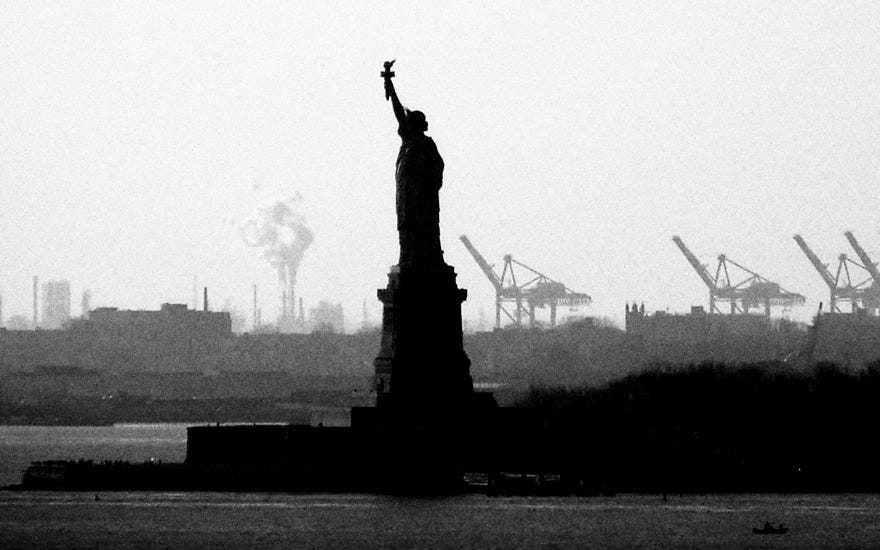
_Statue_of_Liberty_(92068792).jpg)
America’s 250th birthday feels more like a funeral.
The lack of enthusiasm most recently presented itself when a number of musicians set to play in the Great American State Fair concert series this summer recently withdrew, pointing to the polarizing and political nature of the event that had, in their words, been sold to them as a non-partisan and neutral celebration of America.
Popular country music singer Martina McBride wrote as much on social media stating that though she was presented with the opportunity to perform at a “nonpartisan” event, that invitation “turned out to be misleading.”
Yet, despite the fact that America was hardly a nonpartisan harmonious nation 50 years ago, the country still found a way to enthusiastically celebrate its 200th birthday.
In the lead-up to the bicentennial the nation was still dealing with the aftershocks of the Civil Rights era, while the Weather Underground had spent years bombing courthouses, banks, and government buildings in a leftist fueled domestic terror campaign.
Only a year prior, the Vietnam war had ended in heart wrenching defeat - shaking the nation’s confidence in itself.
America was no better off economically. The nation was mired in massive inflation, rising unemployment and pervasive economic despair thanks in part to staggeringly high oil prices.
And yet, despite all the political division and economic headwinds, America’s 200th birthday still featured some of the biggest musical acts in American history.
Legendary artists such as Elvis Presley, The Eagles, Fleetwood Mac, ZZ Top, Lynyrd Skynyrd, Aerosmith, and Bob Seger, among many others, all performed in front of tens of thousands of Americans in packed stadiums all across the country while over 6 million spectators witnessed events like Operation Sail.
Sure, the celebrations were also a product of corporate commercialism in an attempt to reap the financial rewards around the occasion. But underneath the over-the-top advertisements, and despite the immense political divisiveness and continuing social unrest, the American people, as a people, still managed to unify in an outpouring of patriotism and pride.
But how?
Because despite very real differences in opinions over where the country was and where it was headed, Americans were still largely a people with a historic memory and a sense of national “self.”
This sense of self was developed, in part, due to the cohesion forged during forty years of restricted immigration that allowed a singular American identity to solidify beginning in 1924 and ending with the Hart-Celler Act in 1965.
The decision to limit immigration came from a considered belief, held by members of both parties, that national identity required continuity, not just paperwork.
Theodore Roosevelt railed against “hyphenated Americanism,” warning that a man who carried a divided loyalty was no American at all. President Calvin Coolidge, signing the Immigration Act of 1924, was explicit about its purpose: to keep America, American.
These were far from fringe positions, but rather the mainstream conviction of a nation that understood itself as a people, not merely a set of propositions.
America in 2026 is no longer the same nation. In fact, in far too many crucial ways, it is no longer a nation in the traditional sense at all.
The ethnic and cultural composition of the country has been altered so fundamentally from 1976 that inherited national memory, cultural continuity, and common civic reference points have all but evaporated.
It is within this demographic restructuring that America fell victim to a decades-long effort by academic, media, and political elites to redefine America as a “propositional” nation, weaponizing the modern myth that anyone can become an American by simply adopting a set of ideals.
This myth has been pushed by both modern Democrats and Republicans alike, replacing America as a distinct people and place with an America that functions merely as an economic opportunity zone for the world to take advantage of.
These architects have substituted a shared homeland for a hollow, abstract ideological creed that they falsely claim can be traced back to the nation’s very founding.
To accomplish this redefinition, political elites have relied on four specific historical touchstones - what I deem The Four Myths of American Civic Universalism.
Proponents of ‘America is an idea’ use the following texts as a cudgel to redefine the nation - shifting it from a specific people and place to an abstract ideological creed that anyone can adopt, yet, increasingly very few do.
Jefferson’s Declaration of Independence
America as an idea begins with none other than the nation’s founding document, the Declaration of Independence in 1776.
Contained within Jefferson’s preamble is a universalism that at the time perfectly espoused the essence of enlightenment thinking. Two phrases in particular, “all men are created equal,” and “right to life, liberty and the pursuit of happiness,” have been interpreted today to apply not just to Americans, but to the world at large.
Most people, including our elected leaders, stop short of reading beyond the Declaration’s ‘Enlightenment’ preamble. As such, for the vast majority of Americans, its grand assertions that “all men are created equal” and that they have the “right to life, liberty, and the pursuit of happiness” are all that is understood about America’s colonial break from England.
However upon closer inspection, the Declaration served as a carefully crafted diplomatic sales pitch to gain French sympathy and support for the war.
After all, it’s no coincidence that Benjamin Franklin went to Paris soon after, armed with the Declaration’s overt appeals to Enlightenment ideals which resonated deeply with the French.
In reality, the core of the Declaration of Independence is legal in substance, not philosophical, citing 27 violations of the colonists’ rights specifically as Englishmen, which were rooted in the Magna Carta and the English Bill of Rights.
Also worth remembering that the Declaration followed the Olive Branch Petition which argued that the colonists were being denied rights as British subjects.
In short, America’s grievances were more legal in substance, not philosophical.
Ultimately, it is in our English heritage, and not just Enlightenment universalism, that the meaning of this founding document makes the most sense.
Yet, today, “All men are created equal” has morphed into the claim that all cultures are equal. Anyone who seeks “the pursuit of happiness” should be welcomed here, regardless of cultural compatibility. The right to “life” and “liberty” turns into the universal right to immigrate to America and claim its promise for oneself.
Liberals then, under this logic, posit that mass immigration, especially from cultures antithetical to America’s founding culture, is what actually makes America “stronger,” while also functioning as a form of atonement for America’s original sin of slavery and restrictive (i.e., “racist”) immigration laws.
For much of the right, the framing is eerily similar. According to many mainstream conservatives, the American founding was nothing short of a glorious war for universal human principles and ideals.
And so under this framework, anyone who espouses the beliefs of liberty, freedom, and equality and dedicates himself to working hard in his “pursuit of happiness” is definitionally an American-in-waiting.
What gets lost in the lofty rhetorical prose of the Declaration is that the Constitution of 1787 was effectively a counter-revolution to correct for the radical excesses of 1776.
There’s a reason universalists, such as Lincoln, point to the Declaration’s preamble to justify their universalist goals while the American traditionalist position grounds itself in the Constitution’s preamble - “to ourselves and our posterity.”
Without the grounding of the Constitution, the Declaration of Independence becomes the justification for continued demographic transformation via mass immigration which is required to fulfill the Declaration’s “original promise.”
Lincoln’s Gettysburg Address.
GK Chesterton wrote the following in 1922
“America is the only nation in the world that is founded on a creed. That creed is set forth with dogmatic and even theological lucidity in the Declaration of Independence; perhaps the only piece of practical politics that is also theoretical politics and also great literature.”
Though Chesterton is revered by Conservatives today, for good reason, it’s important to note that he was an English outsider describing America as it existed after the revolution that was the Civil War.
What was this revolution? It was Lincoln’s deliberate substitution of an appeal to the Constitution and American heritage with the ‘universal creed’ found in the Declaration of Independence.
Lincoln’s invoking the ‘proposition’ of the Declaration of Independence at Gettysburg served a practical political purpose.
He was fielding a force that was 25% foreign-born which rose to nearly 45% when including second-generation immigrants and so he needed an aspirational and ideological hook.
He couldn’t call upon a shared ‘American’ heritage to unite the German revolutionaries and Irish immigrants that comprised nearly 17% of the Union Army to fight an American South that was 95% native born.
And so Lincoln used the Gettysburg address to shoehorn a universalist rationale for a war initially launched to preserve the Union.
This is not a modern critique. Some newspapers at the time, including those in the North, criticized Lincoln’s universalist framing as a political maneuver.
The Chicago Times wrote on November 23, 1863 in condemnation of Lincoln’s universalist revisionism by stating the following,
“It was to uphold this Constitution, and the Union created by it, that our officers and soldiers gave their lives at Gettysburg. How dared he, then, standing on their graves, misstate the cause for which they died, and libel the statesmen who founded the government?”
Famously adding, “The cheek of every American must tingle with shame as he reads the silly, flat and dishwatery utterances of the man who has to be pointed out to intelligent foreigners as the President of the United States.”
The Times of London also criticized it, writing, “The ceremony was rendered ludicrous by some of the sallies of that poor President Lincoln. Anything more dull and commonplace it would not be easy to produce.”
The Statue of Liberty
There is an egalitarian ethos that dominates modern liberal thinking, especially around immigration, and it has permeated both the political left and right in America.
In what could be called the “Statue of Liberty rationale” for mass immigration, American political elites have turned Emma Lazarus’s “New Colossus” poem affixed to the Statue of Liberty into a form of de facto immigration law, citing it as sacrosanct when any form of immigration restriction is debated in Congress.
In truth, the Statue of Liberty was never intended to be the center of gravity for mass immigration. Rather, it was a gift from France to America commemorating the friendship between both countries as well as America’s 100th Birthday in 1886.
It was 17 years later, in 1903, that Emma Lazarus’s “The New Colossus” poem was affixed to the statue, permanently altering what the statue originally represented, and yet even then it was not directly tied to immigration.
Yet, it wasn’t until the 1930s, in direct response to the restrictive immigration legislation of the 1920s, that pro-immigration advocates, most prominently the Slovenian-American journalist Louis Adamic, took the poem up as a political rallying cry. It was then that the decorative plaque at the base of the Statue was transformed into an ideological cudgel against immigration restrictionism.
Under this new rationale, liberals believe immigrants should be admitted primarily based on how poor or persecuted they are, without any further consideration.
For those on the right who adhere to economic liberalism, immigrants should be admitted primarily based on their economic potential. If they can increase the GDP, they’re welcome.
Tired, poor, hungry? Come on in. Wretched refuse and homeless? The more the merrier.
Using this as a standard for who America admits and who it doesn’t is suicidal. This rationale completely discards the notion that immigration and refugee policy should serve more than abstract feelings of compassion or economic consumerist concerns. Immigration must also, and more importantly, serve the cultural and civic continuity of the nation itself. The reality is that not all refugees or immigrants pose equal benefits — or equal risks — to that goal.
And so the copper Statue of Liberty, once a symbol of friendship between two nations, became a magnet for unfettered immigration
JFK’s “A Nation of Immigrants” and the Civil Rights Act.
Today the phrase, “America is a nation of immigrants” is treated as multicultural gospel on both the political left and right.
But where, and how, did this phrase embed itself so deeply into the American lexicon?
For the answer, we need look no further than President John F. Kennedy.
John F. Kennedy first published an essay titled, “A Nation of Immigrants” in 1958. The essay was commissioned by the Anti-Defamation League, and then was subsequently expanded into a book that was released posthumously in 1964.
That year is significant as it was used to help justify the passing of the 1965 Hart-Celler Act which reframed America as a nation that should be welcoming to all immigrants after the 40+ years of immigration restriction that began in 1924.
Today, this phrase and the policies that have arisen under its banner, have done incredible damage to America’s social fabric by radically changing American immigration law.
Since the Immigration Act of 1924, America had operated on a National Origins Formula. This system calculated immigration caps based on the existing ethnic proportions of the country, specifically favoring Northern and Western Europe in an effort to maintain cultural continuity.
Hart-Celler completely abolished these quotas and banned any discrimination in the issuance of immigrant visas based on race, sex, nationality, place of birth, or place of residence.
In many respects The Hart-Celler Act of 1965 became an extension of the Civil Rights Act of 1964.
While the CRA sought to end discrimination for those already living in the U.S., Hart-Celler extended this principle outward, arguing that America had no right to discriminate against who could become Americans.
In essence, it made it illegal to prefer immigration from mainly European countries and restrict immigration from third-world countries, granting a de facto “right” for anyone in the world to become an American.
But it gets worse. It also instituted a rigid 20,000 per-country cap that treated foundational European nations no differently than third-world countries, and handed 80% of visas over to a family reunification preference system. This system unleashed a wave of uncapped chain migration that exists to this day.
By eliminating the preference for European lineage, Hart-Celler stripped America of its lawful ability to protect its heritage.
The 1965 Hart-Celler Act deliberately changed the ethnic makeup of America, even when those who supported it promised Americans it wouldn’t.
(D) Sen. Ted Kennedy stated, “The bill will not flood our cities with immigrants. It will not upset the ethnic mix of our society.”
Republican Hiram Fong said, “Our cultural pattern will never be changed as far as America is concerned.”
Secretary of State Dean Rusk added, “Additional workers would not even be competitors for jobs held or needed by Americans.”
After signing the Hart-Celler Act into law, (D) President Lyndon B. Johnson said: “It does not affect the lives of millions. It will not reshape the structure of our daily lives.”
Of course, none of what our elected leaders said was true.
In 1960, 84% of legal immigrants were from Europe or Canada. Only 6% were from Mexico. 4% were from South and East Asia. 4% were from Latin America. 2% were from other parts of the world.
Additionally, the total foreign born U.S. population was around 5%.
By 2023, Mexico alone accounted for 22% of all immigrants, with India, China, and the Philippines making up another 16% combined. Europeans and Canadians had fallen to just 12% of the foreign-born population, while the total foreign born population hit a record high of 15.8% in 2025.
Keep in mind these are “official” legal immigration statistics. The official numbers are assuredly higher once illegal immigration is factored in.
Hart-Celler became the legislative instrument that officially severed the American people from their national heritage — and the politicians who passed it knew exactly what they were doing.
Towards Renewal
In the relatively brief 50 years since America celebrated her 200th birthday the nation has undergone a dramatic cultural transformation - the seeds of which can be traced back to the very founding of the nation itself.
Though not the whole story, four separate texts, selectively misread, distorted, weaponized, and enshrined into law, combined to sever over 200 years of American heritage from the collective consciousness.
For most of that time, America understood itself to be a people, and not a proposition.
These were unhyphenated Americans who, despite the ebbs and flows of immigration, still managed to hold on to their collective identity right up until it was made illegal to do so in 1965 and beyond.
If America is to ever experience a renewal, it must first understand not only what was taken from it, but the mechanisms, etched in American mythos, that allowed it to happen.
A condensed version of this article is featured at The Federalist so be sure to head over there for more great Conservative content. You can also subscribe to The Federalist, and donate to help support all their great journalism. Thank you!
White Americans are a minority in 11 US states and will be a minority in at least 5 more before the next census. But nowhere in government is there a department of White minority affairs.
As a White Male American, I am a fourth class citizen behind non-Whites, sexual deviants and women of all races.
What's to celebrate?
Usonia was never a nation in the traditional sense.
Blacks arriving since the very beginning meant that the equation of a nation "natus" (born from) didn't hold true to its meaning since then.
The USA was born as an empire, first as a en empire with african subjects, then with african and indian subjects, and then extending to other ethnicities globally both by importing them and conquering them (Puerto Rico, Guam, etc)
The only reason why many thought and still think that it was a nation at all ever, is because of the vast geographical space and the deliberate policy choice to separate (both physically and mentally) the euro-americans from everyone else. But even this Potempkin-nationalism was still just a lie.
Now is more obvious that is a multi-national, multi-ethnic global empire, which has always been formally the case (Washington saw the Indians as being their own nations), but is now just very blatant.
Why usonians loved its "nation" then and are dissilusioned now? because before the explotation and harsh conditions fell squarely on the blacks, or the chinese who built the railroads, etc, and since the 1960s, that same exploitation started to be targeted also at euro-americans, but even in this, the reasoning was the same, imperial and capitalistic expansion.
Anywho, good riddance, may God replace the USA chimerical, epstein-class ridden empire with something less malevolent.