Ken Burns' Reframed Revolution
How a Progressive Lens Warps the Story of America’s Birth.
This article is featured at AMAC. To learn more about AMAC and how you can become a member to receive exclusive benefits - click HERE.
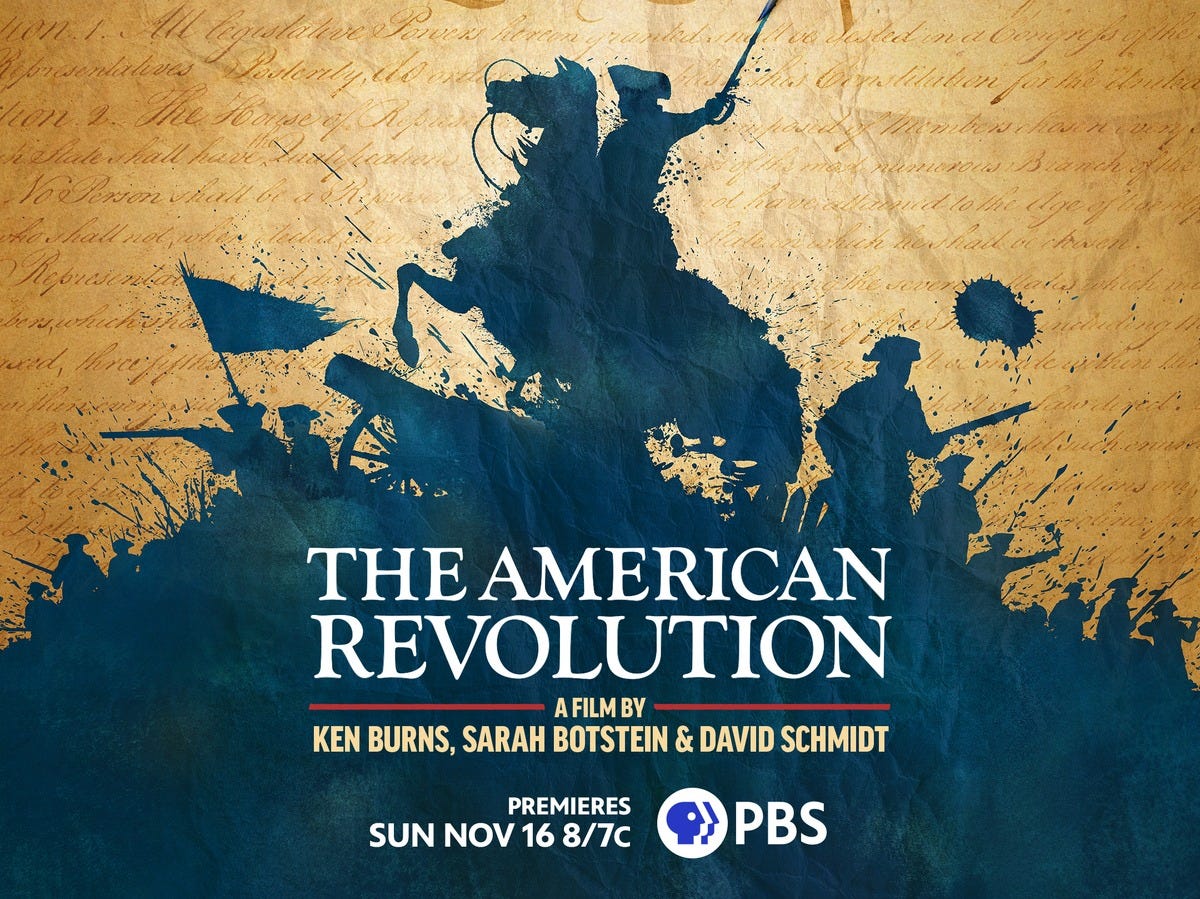
As the United States approaches the 250th anniversary of the signing of the Declaration of Independence, filmmaker Ken Burns has released his long-anticipated six-part PBS special, The American Revolution. Unfortunately, the docuseries is tainted by a healthy dose of ahistorical woke nonsense.
The project took nearly eight years to make, and is marketed as a sweeping, definitive retelling of the nation’s founding that shows how “America’s founding turned the world upside down.”
To its credit, the series is extensive. It highlights the Revolution’s complexity as a struggle against the British Crown, a civil war between patriots and loyalists, and, too often overlooked, part of a global conflict fought between Britain and France.
Yet from the opening minutes, it becomes clear that this series is not simply an attempt to present the Revolution as it occurred. Instead, it is in some ways an effort to reframe the conflict through a decidedly progressive lens.
Case in point, the documentary does not begin with George Washington, John Adams, Thomas Jefferson, or even King George III. Instead, it opens with what amounts to a land-acknowledgment sequence, featuring the words of a spokesman for the “Six Nations” of the Iroquois Confederacy.
Watch the clip below and see for yourself:
The viewer is told that the Iroquois understood the rising value of their lands after the arrival of European settlers, but that “white people” believed they did not. This quickly portrays the colonists in a negative light.
We are also informed that the Six Nations presided over a centuries-old democratic system that predated, and somehow inspired, the governing structure of the 13 colonies.
Finally, we are told that Benjamin Franklin admired the Iroquois system so profoundly that he borrowed its model when envisioning a union of American states. All of this appears in the first three minutes.
In short, the introduction is propaganda disguised as history.
While there is some truth to all these claims, it’s worth remembering that propaganda is not effective because it invents a narrative out of whole cloth. It works because it blends truths, half-truths, exaggerations, and omissions into a coherent (but false) narrative that then shapes the lens through which all subsequent information is interpreted.
By framing the American Revolution, and by extension the American founding, through an Iroquois-centered narrative right from the beginning, Burns sets the viewer’s interpretive framework before any actual Founding Father appears on screen.
A kernel of truth, such as “the Iroquois had a centuries-old thriving ‘democracy,’” morphs into “the Iroquois provided the governing model for the 13 colonies.”
In the same way, a historical observation, such as “Franklin referenced the Iroquois Confederacy,” is inflated into “Franklin was heavily influenced by the Iroquois.” This claim conveniently omits the far more consequential influences on the Founders, such as the functioning of Greek city-states and the Roman Republic, along with political thinkers such as John Locke, Montesquieu, David Hume, and William Blackstone, just to name a few.
Rather than being the ideological inheritor of Greece and Rome, the Burns docuseries reduces the genius of the Constitution and the wisdom of the Founders to a pale imitation of a loose alliance of Native American tribes. Also deliberately absent in the discussion is the British constitutional system itself, which is the very system the American one descends from.
Instead, the viewer is offered a simplified “progressive” narrative: Franklin borrowed from the Iroquois, and the Iroquois were early democratic geniuses. In other words, the Iroquois could be seen as the real Founding Fathers.
Yet, Franklin’s own words completely disprove this framing.
In a letter to James Parker, his New York printing partner, Franklin invoked the Iroquois not as a philosophical model but as a rhetorical prod to embarrass the colonies into unity:
“It would be a very strange thing, if six Nations of ignorant Savages should be capable of forming a Scheme for such an Union… and yet that a like Union should be impracticable for ten or a Dozen English Colonies…”
In short, Franklin’s point was: If six Indian nations commonly dismissed as “savages” can form a union, then surely we can manage it as well. Regardless of one’s feelings about that sentiment, it is not historically accurate in the least to suggest that the example of the Iroquois was a primary “inspiration” of Franklin’s vision for the United States.
Of course, that politically incorrect context is conveniently left out of the story.
But the narrative is already solidified, as the omission of Franklin’s words creates the desired effect in reframing the discussion.
Historical revisionists have long understood that once a narrative is established within the mainstream media and the education system, it becomes extraordinarily difficult to challenge. Counterarguments, however well-sourced, are framed as nitpicking, bad faith, or even propaganda in their own right.
And so, Burns’s initial framing becomes self-reinforcing, especially when modern events seem to support the narrative, such as the 1987 Senate Resolution stating that the United States owes a “historical debt to the Iroquois Confederacy and other Indian nations for their demonstration of democratic principles.”
However, this resolution was crafted by legislators, not historians, who were clearly engaging in political symbolism (i.e., virtue signaling) rather than true scholarship.
But when we turn to the historical record itself and examine the actual words and writings of the Founders, a very different picture emerges.
As Dan McLaughlin of National Review notes, few figures in world history left behind a more extensive or transparent record of their political thinking than the American founders.
And yet, within this vast historical library, the Founders made only the briefest, almost incidental references to Native American political structures. Even The Federalist Papers, written for a New York audience living amid the territory of the Six Nations, look elsewhere for their examples of model governance.
In fact, John Adams, who McLaughlin notes devoted the most attention of any contemporary American theorist of government to Native American governing structure, only mentions Native Americans six times in his sprawling three-volume work, A Defence of the Constitutions of Government of the United States of America in 1787–88.
And yet, the Iroquois founding myth remains because progressives do not see this over-emphasis as historical revisionism, but rather as historical self-correction.
The irony is that those who accuse the Trump administration of sanitizing American history are engaging in a sanitization of their own, discarding the Founders’ actual intellectual and cultural inheritance in favor of a myth that elevates historical footnotes, such as the influence of the Iroquois Confederacy, above that of the true inspirations for the American founders.
In its review of The American Revolution, NPR stated, “Ken Burns…will make you think differently about U.S. history.” The New York Times further elaborated on this point, explaining, “When you control how people discuss the past, you control how they see the present and imagine the future.”
The way Ken Burns chose to begin his new series is a clear demonstration of that principle in action.
Whether it’s the 1619 Project that attempts to reframe U.S. history by placing the consequences of slavery at the center of our national narrative, or Burns’s The American Revolution elevating the Iroquois to an outsized role in our founding, the progressive desire to deconstruct and distort the story of the birth of the United States is central to the left’s political project of controlling America’s future.
If we accept history as something that may be rearranged to suit contemporary narratives, we lose the ability to understand the past. But, for a political movement looking to “reimagine” what America means, that is the entire point.


Thank you, Adam for an excellent and fact filled refutation of Ken Burns’ dreadful new documentary series on the American Revolution. I have not watched it and don’t plan on doing so. It has its good points as you point out, but overall it’s a train wreck. Once, Ken Burns was a great filmmaker who was impartial and unbiased. Now he has been MSNBCified and decided to inject partisan and identity politics into the story of our founding. It’s true the Iroquois Confederation did practice democracy but they were not what inspired the founding fathers. They were inspired by the Greeks, the Romans and the British, Scottish and French Enlightenment thinkers. Ben Franklin’s letter furthermore was taken out of context. He was saying if the Iroquois could build a united confederation of states even though no one believed them capable of it, why can’t we? Nowhere in the letter does he suggest inspiration from their system. By the way, they sided with the British in the Revolution.
Ken Burns sounds more like Howard Zinn or James Loewen then someone trying to make a film that honestly recounts the past. He curiously leaves out the true intellectual foundations of our founding. Why? To push a certain progressive narrative. Yes, the Senate did pass a resolution in 1987 thanking the Iroquois for inspiring American democracy. But we must remember this was a resolution crafted by politicians for political purposes, not by historians in order to give an honest look at the past. This documentary is an embarrassment to this great country and completely disrespectful to the brave men and women of all races, creeds, ethnicities, and backgrounds who gave their lives to bring our nation into the world!
No mention of the Iroquois destroying the Erie and Huron tribes. Wiped them out.