Act Worthy of Yourselves: A New Year's Message
"Tyranny, like hell, is not easily conquered"
“These are the times that try men’s souls; the summer soldier and the sunshine patriot will, in this crisis, shrink from the service of his country; but he that stands it now, deserves the love and thanks of man and woman.”
- Thomas Paine, “The American Crisis”
History is rarely a straight line of progress. More often, it unfolds as a series of recurring crises that test a nation’s character.
Just as America faces profound uncertainty today as it confronts fundamental questions of national identity and sovereignty, the men of the American Revolution stood at a similar crossroads 250 years ago.
Following America’s formal Declaration of Independence, Washington’s army suffered a string of defeats, barely escaping the British in New York, retreating through New Jersey and into Pennsylvania, eventually finding refuge on the frozen banks of the Delaware River.
With enlistments set to expire, and his men freezing, starving, and demoralized, Washington made a daring gamble and decided to go on the offensive.
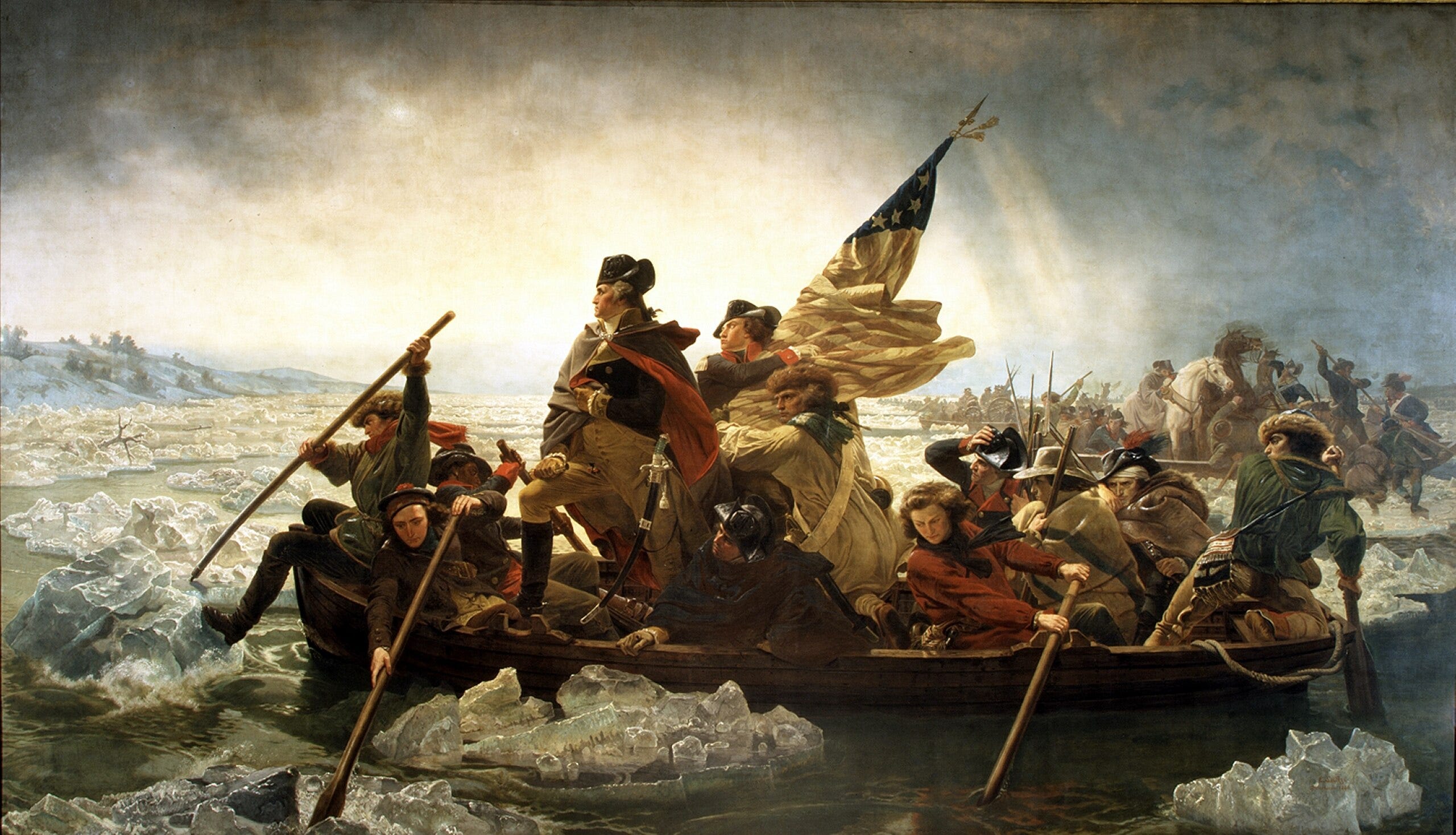
On Christmas Night, Washington’s army moved approximately 2,400 men, along with 50 horses and 18 artillery pieces across an icy Delaware River into New Jersey. The Americans then marched 9 miles through a snowstorm, with troops lacking shoes leaving bloody footprints in the snow, before launching an attack on the Hessian garrison in Trenton on the morning of December 26th.
Having seized the element of surprise, Washington ultimately won the first Battle of Trenton, lifting morale in his army and securing a much-needed victory for American revolutionary cause, which had been on the brink of defeat.
But Washington was not satisfied.
Washington’s army would then cross back into Pennsylvania, before recrossing the Delaware River again over the next week, winning the Second Battle of Trenton, before fighting a delaying action at the Battle of the Assunpink Creek and then winning another incredible victory at the Battle of Princeton.
These “Ten Crucial Days,” from the crossing on December 25, 1776, to the Battle of Princeton on January 3, 1777, helped change the course of American Independence.
“Tyranny, like hell, is not easily conquered; yet we have this consolation with us, that the harder the conflict, the more glorious the triumph.”
- Thomas Paine, “The American Crisis”
How these men continued to fight despite enduring horrific conditions and facing insurmountable odds is hard to comprehend. Though success was far from guaranteed, their sacrifices were rewarded with a glorious string of victories.
As it turns out, ordinary men can accomplish extraordinary things.
The regiment that helped Washington stave off annihilation in New York by ferrying over 9,000 soldiers across the East River under cover of darkness, and later rowing his army across the Delaware River was the 14th Continental Regiment, known as the Marbleheaders - as they hailed from Marblehead, Massachusetts.
Fishermen by trade turned soldiers, the ranks of Glover’s Regiment also sacrificed a great deal for the cause of American Independence.
Author Patrick K. O’Donnell highlights their incredible exploits and sacrifice within his must-read book, “The Indispensables.”
“The members of the Marblehead Regiment often fought for no monetary gain and became broken men—physically, economically, and mentally. Some paid the ultimate price, surrendering their very lives. They served honorably, against tremendous hardship, and did not desert their brothers in arms. The price to Marblehead was enormous in blood and treasure. By the end of the war, the town had 378 widows, 35 percent of the female population in the town, and 652 children would never see their fathers again.”
We don’t often hear about the sacrifices of ordinary Americans during that time, as most of the rhetoric centers around the eloquent words of the Founding Fathers and the Declaration of Independence.
But the American Revolution was not won with words scribbled on parchment. It was won through the active participation and sacrifice of ordinary people like those in Marblehead.
Similar to the crisis faced by the American cause in 1776, modern America now finds itself in a struggle for its very sovereignty.
The country is ideologically occupied by a postwar liberal consensus - on the political Left and Right - that either treats the nation either as irredeemably racist and founded on stolen land, or an abstract propositional nation, rather than a people with an inherited culture, history, and way of life.
At the same time, large-scale mass immigration—both legal and illegal—has transformed entire neighborhoods and cities into ethnic enclaves without the consent of the American people, producing parallel societies that are either detached from, or hostile to, the nation that hosts them.
Nations that lose control of their borders, laws, and cultural continuity eventually lose their sovereignty altogether.
Just as Hessian garrisons and British Redcoats symbolized the presence of foreign power on colonial soil, today’s American crisis is defined by the visible erosion of America’s character and identity.
While this erosion has not been facilitated by uniformed armies, mass immigration at the scale America has been subjected to functions as a form of conquest all the same: a mass movement of foreign populations into a nation without the broad consent of its people, facilitated by ruling elites, resulting in the steady displacement of cultural norms, political priorities, and national identity…until one day a people awaken to find that the country they inherited no longer belongs to them.
Though political efforts by the Trump Administration have demonstrated that policy can stop, slow, or even reverse these trends, the scale of the damage inflicted over decades will not be undone in a single presidential term.
Politicians obviously play an important role in helping turn the tide through the attainment and wielding of political power, but the ultimate survival of a nation, much like it did back in 1776, depends on the resolve of its people.
This is the state of America as we gear up to celebrate America’s 250th birthday later this year.
Despite seemingly overwhelming odds, find solace in knowing that you belong to a lineage of patriots, men and women, who responded to this call despite seemingly insurmountable challenges. Ordinary individuals, not just the founders, committed their lives, fortunes, and sacred honor to fight for their convictions, their families, their heritage, and their homes.
Victory will require the same level of commitment to overcome the malevolent forces equally determined to destroy all that is good about our country and Western Civilization at large.
The words of Dr. Joseph Warren are as true today as they were during the early days of the American Revolution.
“Our country is in danger, but not to be despaired of. Our enemies are numerous and powerful, but we have many friends, determining to be free, and heaven and earth will aid the resolution. On you depend the fortunes of America. You are to decide the important question, on which rest the happiness and liberty of millions yet unborn. Act worthy of yourselves.”
As America and the West grapple with cultural and political upheaval through demographic transformation and ideological capture, we metaphorically stand on the icy shores of the Delaware River.
We can honor those who came before us by demonstrating ourselves worthy of their sacrifice, opting once more to cross the frozen river, in the face of overwhelming odds, to fight for what we hold dear, just as our ancestors did 250 years ago.
Happy New Year. Act worthy of yourselves in 2026.